Showing posts with label strategies. Show all posts

Friday, January 13, 2017

Teaching Theme & Comparing Events

RL 4.9 Compare and contrast the treatment of similar themes and topics and patterns of events in stories, myths, and traditional literature from different cultures.


This one was tricky for my students.  The stories are from two completely different authors, two completely different cultures and events, and two completely different story lines...or were they?

"Wading Pool"
At first, I started small.  We had to get our feet wet, before we could dive head first into this one. I found similar fairy tales written from different cultures' perspectives.  Cinderella is one of the easiest to find!  There are many versions of Cinderella from almost every culture and while this is not meeting the standard exactly, it was a starting point.  It allowed my students to focus on the the overall shared theme, and even pattern of events, but to try to find the unique characteristics of each culture first.  And for my Midwest group with little diversity, a window into other cultures was vital before we jumped into the deep end. 


"Tippy-Toes Touching"
Once I felt like my students could pull apart small cultural differences between stories they were well familiar with, I was ready to introduce them to new folktales that shared a similar theme, however, each culture had their own way of achieving that theme.  

I began with this discussion handout to lead our thinking about each text that we come to:
This helps students develop vital vocabulary to help them
analyze these folktales at a deeper level.
Click here to download this resource!
It became evident that each culture showed specific behaviors that were especially valued through the arrival of a universal theme.

For instance...
I always begin my instruction with this Japanese folktale.  I fell in love with the culture, their values, and the events that lead us to the theme.  "Mr. Lucky Straw" is  a folktale that tells of a young man who has very little at all.  This is key to the theme.  We follow him along his journey as he meets many people along the roadside.  Each person he meets, he offers them something of his own, and without expecting anything in return, he receives something in greater value than what was given.  
Throughout this story, I have my students collect the behaviors that are clear the Japanese culture values.

Such as: generosity, caring, resourcefulness, kindness, etc.

We used these behaviors to discuss the behavior shown throughout the text:  generosity.  This was used to develop a theme statement.  We decided on 
When you give to others, you get more in return.
This could mean literally, or figuratively.

"Deep End"
Next, we jumped into another folktale that showed great generosity from the Native American folktale.  "The Legend of the Bluebonnet" also begins with a young girl who has little and no family.  The spirits ask her to sacrifice the only thing that matters to her at all:  the doll left behind from her family.  She does and saves her people from a seven year drought.  
This folktale shows similar behaviors that are valued as the Japanese culture.  We used this similarity to find in what ways both cultures show generosity. 
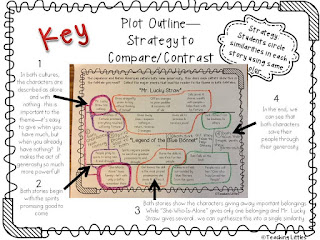
We plotted each event that showed us the theme for each story.  We then found similarities between each and synthesized them into concise statements.  The events in each story became our evidence to explain the similarities, but naturally, they were done in different events so that also became our differences.

We continued this process using other folktales from different cultures, displaying similar themes. 

Like what you saw?  Check out my TpT store, Teaching Littles, to purchase this complete 2 1/2 week unit, including all the resources you saw in the post!

How do you teach RL 4.9?  
Comment below to share your strategies!  

Thursday, December 22, 2016

Teaching Your Littles to Summarize

Teaching fourth graders to summarize what they're reading is no small undertaking.  You see, there are two types of summaries you will receive from your little.  There's the "short-and-not-so-sweet" summary that lacks all vital details that would vaguely help the summary make any sense at all...or the "this-is-my-version-of-the-entire-story-rewritten" summary, of which the student copies line after line from the story, omitting zero information from the text, calling it his/her OWN summary.  😐

Does this sound like your classroom?  It sure did mine, until...

RL 4.2 requires students to determine a theme of a story by referring to the details in the text AND summarizing that text.  After reading this standard for maybe the, I don't know, umpteenth time in a row, it clicked.  I was teaching these skills in isolation, not as a stepping stone for the latter.  When teaching students which details to pull from the text to support a given theme, it would later be used as a strategy to help them decipher which details were important enough to include in the summary! 

Here's the Breakdown:

1. Theme.  Students had to be able to read a text and identify the theme the author was teaching the reader. 

For example, in "A Bad Case of Stripes" by David Shannon, the theme is to always be yourself.  

A colleague once said, when teaching theme it's important to ask your readers, "Did the author sit down one day and decide to write a story about a girl who wouldn't eat Lima beans and therefore turned into a house?!  NO!  He wanted to teach us to be ourselves even if that means standing out...the girl with the Lima beans taught us that valuable lesson."  We must help them understand the big picture of the story...the lesson we learn about the world around us and ourselves.  That's the meaning of reading, after all.

2. Evidence.  It is vital students practice identifying strong pieces of evidence to support their thinking.  It shows a deeper level of understanding--the 3rd level of Webb's Depth of Knowledge. 
This is an on-going skill for some students.  It's important to let students critique one another, sharing if they felt that one piece of evidence was the best proof that theme was included in the story or if another would have been more clear.  


This is the moment where students start asking the question, "But does it really show the reader the theme?"  If the answer is no, it wasn't that necessary to include as evidence.  When they can get to this conclusion...they're ready for summarizing.  

3. Summary. When students are capable of evaluating the information they are pulling from the text, the summary becomes more purposeful.  This is key.  A summary with a purpose.  No more guessing what to include or what not to include.  

I taught my fourth graders to think of the theme as the conclusion for the summary.  Everything in the text that helped the author lead up to the theme would be important to include in the summary.  If it was an interesting detail that held the reader's attention, it could probably be omitted.  This helped them ask that vital question again and again! "Does it really show the reader the theme?"

We collected a chart to help us remember story elements that may impact the theme such as:
  • What is the character like in the beginning?
  • What makes them this way?
  • Does something important happen to them?
  • How do they react?
  • Does anything help them grow or change?
  • How do they change?
  • What do they learn?
We felt like if they were answering these questions, the theme would be quite clear in their summary!

While this standard is quite vague...how did I decide what made an acceptable summary?  Our fourth grade team debated what we felt must be included in a summary to call it mastery.  We created the following rubric to show the expectations clearly:
Click here for a free download of this rubric.

In the end, my students were creating concise, but thorough summaries...a description I had never used to describe my students' summaries.  This strategy worked wonders on my instruction and their mastery of the skill.  I hope it works for you!

Have a summarization strategy you love?  Share it below!

Wednesday, November 30, 2016

Creating Math "Attack"ers

Word problems.  The scariest task for most students and the most overwhelming lesson for most teachers to instruct.  It's the skill many teachers claim, "some students have and others just don't".  Or is it?  Can we reach the most unsuccessful students and even more can we shift this task from being perceived as an intimidating burden into a challenging brain teaser that's fun!?

This year I have joined the club and have added a new buzz word into my students' vocabulary: growth mindset.  The growth mindset instills that failure is just a stopping point on the way to success.  It's not the end of the journey!  

We have begun using phrases in our classroom such as:
"I don't have it YET, but I will." 
not "I can't do this."
and
"I made a mistake, but I learned..." 
instead of "I stink at this."

This language is vital when placing students in situations they are hesitant and unsure about.  It creates a climate that encourages one another to challenge themselves and to not be afraid of failure! Word problems are scary to students whom not only struggle with the math concepts, but also in the simple task of breaking down the problem.  

Ergo...the strategies!  Oh, the strategies! 
Discuss word clues.
Teach organization.  
Create visuals.
Encourage discussions
Share misconceptions.

Word clues are the clues that help make the puzzle fun!  Once students understand that the word problem provide them with all the information they need to solve, it shifts from an endless wandering into a purposeful plan of attack!  Those word problems have become impossible possible!
The word problem included that each student collected a certain number of cans.  The student recognizes that if "each" is used as a clue word, she can multiply to find the total number of cans.  She also boxes "how many more" and identifies this as a subtraction clue word.  Now, she has a clear plan to attack the problem!

Organization, a scattered brained, 4th grader's best friend!  It sounds so simple, but it isn't a strategy that comes naturally...it is a skill that must be taught.  Spacing is key.  Many students begin solving problems within the mult-step word problem and lose track of where they are and what they still need to solve.  This is where many students give up.  We must teach them to keep track of their own progress as they are solving.  When they plan the number of steps they will need to carry out to solve the problem, organizing a clear space to complete each of those steps is a simple strategy to focus students that become overwhelmed easily. Labeling each step helps students feel like they have a checklist to carry out.

It's important to teach students to organize problems using divided areas, labels, and clue words for themselves to keep track of what they have solved and what they still need to solve.


Click HERE for a Christmas themed multi-step word problem FREEBIE from my TpT store!

Visuals help students identify exactly what the words mean.  Common core encourages students to create models when solving math problems.  Students need to be shown how and when to use this strategy.  

Discussions provide opportunities to share their own strategies and hear others.  In the beginning of the year when students share out how they solved a word problem whole group, if a student's idea looked different then their own, they quickly said it was wrong.  Regardless if they calculated the same answer, they were sure the student was wrong.  At this age it is so important to teach students that there is more than one way...this can be surprising to many!  The fun part begins when they start to understand this and comment on the strategy the student used to solve the problem.  They begin to notice other strategies that work and may have been more simple than their own.  They encourage one another and give tips on what to do next time.  The discussion becomes student-led and the roles shift.  Students take more ownership, ask questions for clarification, and challenge one another. This is where the magic happens, my friends.

These students were having a fantastic discussion regarding their own ways of solving the problem.
Two strategies, one great discussion!

Don't be afraid to let them share misconceptions.  This is where the true learning takes place.  While it may not seem like a strategy for solving word problems, it is one of the most valuable strategies I use in my classroom.  This allows students to share moments that confused them and ask questions for the future.  This is another step in the growth mindset.  It encourages students to share their mistakes, to learn from themselves, and others, instilling self-monitoring.  

For example, a student shared when solving this problem they estimated.  They saw "an average" in the problem, didn't read closely enough, and accidentally estimated the difference rather than solving for the exact difference.  This provided an opportunity to discuss the word "average" in this context.   

Word problems have become an engaging brain tease, rather than a scary, impossible challenge.  You'll be amazed what a little organization and the right mindset will do for your students, as well!

Looking for your own multi-step word problems to try with your students?  Check out these fun Christmas themed multi-step word problems by clicking HERE!

Thanks for reading!  
Leave a comment to share what you try in your classroom to make word problems a little less scary!